

Johan Manzambi's World Cup Record: How Switzerland Finally Beat Their Knockout Curse Against Algeria
Since FIFA started tracking individual World Cup data in 1966, no player has reached five goal involvements at a single tournament faster than Johan Manzambi.
Since FIFA started tracking individual World Cup data in 1966, no player has reached five goal involvements at a single tournament faster than Johan Manzambi. The Freiburg forward hit the mark - three goals and two assists - at 20 years and 261 days old, in just four games. He set up the record with a burst down the left in the 10th minute of Switzerland's Round of 32 tie with Algeria in Vancouver, teeing up Breel Embolo for the opener in a match that ended 2-0 and did something no Swiss side had managed in 88 years: win a World Cup knockout game.
That combination - a teenage breakout and a historic monkey off the back - is why this result will still matter as a reference point long after the score itself is forgotten. Switzerland's 2-0 win over Algeria at BC Place on July 2-3, 2026, sent Murat Yakin's side into the last 16 to face the winner of Colombia vs Ghana, but the numbers from the 90 minutes are what will keep this match relevant.
The payoff: how the 88-year wait ended
Algeria, under former Switzerland boss Vladimir Petkovic, actually started the brighter of the two sides. In the sixth minute, Rafik Belghali's cross found Houssem Aouar in space, but he failed to make clean contact and the chance went begging - Algeria's best moment of the half. Four minutes later, Switzerland made them pay: Manzambi picked the ball up on the left, drove at the Algeria back line, and squared it for Embolo, who finished from close range to make it 1-0 in the 10th minute.
The killer blow came almost immediately after the restart. Just 48 seconds into the second half, Ramy Bensebaini's pass toward Rayan Ait-Nouri was cut out by Denis Zakaria, and the loose ball broke to Dan Ndoye, who drilled it into the bottom-left corner from just inside the box. Per Opta Analyst, the goal landed at the 45:46 mark of match time - the fastest second-half goal in a World Cup knockout match, excluding own goals, since Davor Suker's strike for Croatia against France in the 1998 semi-final (45:25). Algeria never generated a genuine route back.
The closest Algeria came after that was a low-percentage look for Riyad Mahrez in the 50th minute, blocked by Manuel Akanji - Mahrez's former Manchester City teammate, now on the other side. Substitute Fabian Rieder later failed to add a third from close range in the 81st minute, sparing Algeria a heavier margin but not changing the outcome.
The underlying numbers back up the scoreline being no fluke. Switzerland's expected goals for the match sat at 2.52 against Algeria's 0.73, a gap that reflects a Swiss side taking its best chances and an Algeria side struggling to turn territory into danger. Algeria actually held the ball more, with 56% possession - the fourth straight match of this tournament in which they out-possessed their opponent, a first in their World Cup history - but volume of possession and quality of chance created were two very different stories in Vancouver.
Switzerland's win was also historically significant on its own terms. It was their first World Cup knockout victory since 1938, snapping a run of elimination in each of their previous seven knockout ties at the tournament, and it marked the first time the Swiss had scored twice in a World Cup knockout match since a 7-5 defeat to Austria back in 1954.
Context and depth: Petkovic's old club, and how the game turned
The pre-match subplot was always going to be Petkovic facing the country he managed for seven years before Yakin succeeded him. In the event, the tactical story ran against the sentimental one. Petkovic's Algeria pressed early through Aouar and Belghali, then found themselves chasing the game once Switzerland scored - a pattern that had defined Algeria's tournament, with seven goals conceded across four matches disproportionately coming after they lost control of the game state.
Yakin's approach was built around the same trigger that had worked in the group stage: getting Manzambi and the wide attackers running at defenders in transition rather than asking Switzerland to dominate possession in a settled block. That the plan produced a goal inside ten minutes, and a second inside a minute of the restart, is a reasonable marker of in-game management working as designed. Petkovic's Algeria continued to hold the ball for long stretches without materially changing their attacking output, suggesting the deficit was hard to claw back once it opened. Algeria's front line, shorn of a reliable outlet once Mahrez was nullified, never generated a second-half chance to match Aouar's early one.
For Switzerland, the platform was Xhaka. The Sunderland midfielder made his 150th international appearance in this match, becoming the first Swiss player to reach that landmark, and did so as the metronome behind a team that finally solved the puzzle that had beaten it for nearly nine decades. Switzerland now face Colombia or Ghana with a settled, in-form group and a manager whose substitution pattern - impact players introduced to exploit tired legs - has produced results in both the group stage and the first knockout round.
Player performance ledger
Johan Manzambi produced the individual highlight of the match: his run and cutback set up Embolo's opener, taking his tally to five goal involvements (three goals, two assists) in four games - the fastest anyone has reached that mark at a World Cup since records began in 1966, at 20 years and 261 days old. Transfermarkt's valuation moved to an estimated €50m as of late May 2026, before this performance, while Sky Sports separately described him as a "£42m-rated" Newcastle target - a fee figure to read alongside, not blended into, the Transfermarkt estimate.
Breel Embolo scored the opener in the 10th minute, a close-range finish off Manzambi's cutback, combining directly with Switzerland's breakout forward for a decisive goal at the biggest possible moment.
Dan Ndoye scored Switzerland's second just 48 seconds into the second half, finishing a loose ball from just inside the box after Zakaria's interception - a goal Opta confirmed as the fastest second-half strike in a World Cup knockout match since 1998. It was the moment that turned a promising Swiss position into a match-defining one.
Granit Xhaka made his 150th appearance for Switzerland, the first Swiss player to reach the milestone, as the side's control point in midfield during their first knockout win in 88 years. Now 33 and playing for Sunderland after a reported €20m move from Bayer Leverkusen last year, his Transfermarkt-listed value sits in the €8-10m range - a figure driven by age far more than his continued on-pitch influence.
Riyad Mahrez was kept quiet by a Swiss defence built around his former Manchester City teammate Manuel Akanji, who blocked his one clear sight of goal in the 50th minute - a subdued night for Algeria's captain after his record-setting group-stage form.
Houssem Aouar had Algeria's best chance of the match in the sixth minute, failing to connect cleanly with Rafik Belghali's cross inside the box. It was a preview of Algeria's night: promising positions, without the finishing touch to match.
Where SVM comes in
A 20-year-old going from a bench option in June to a €50m-plus valuation and a World Cup scoring record by early July is the kind of performance-driven repricing that moves faster than reputation can keep pace with. SVMarkets tracks that gap in real time, turning verified match output like Manzambi's five goal involvements into a clear read on shifting exposure rather than a take built on name recognition - the edge sportvalue.app is built to surface.
The Takeaway
Two numbers will outlast the headlines from Vancouver: Switzerland's first World Cup knockout win in 88 years, and a 20-year-old reaching five goal involvements faster than anyone in six decades of World Cup record-keeping. The xG gap (2.52 to 0.73) explains the scoreline; Manzambi's contribution explains why this match will be cited long after the bracket moves on. Petkovic's return to face his old side made for a good subplot, but the lasting story is Switzerland finally answering a question about their knockout football that had gone unanswered since 1938 - on the back of a teenager who has rewritten the record book in the process.
저자: John Dawson

챌린지 존
0개 게임 이용 가능
최신 뉴스
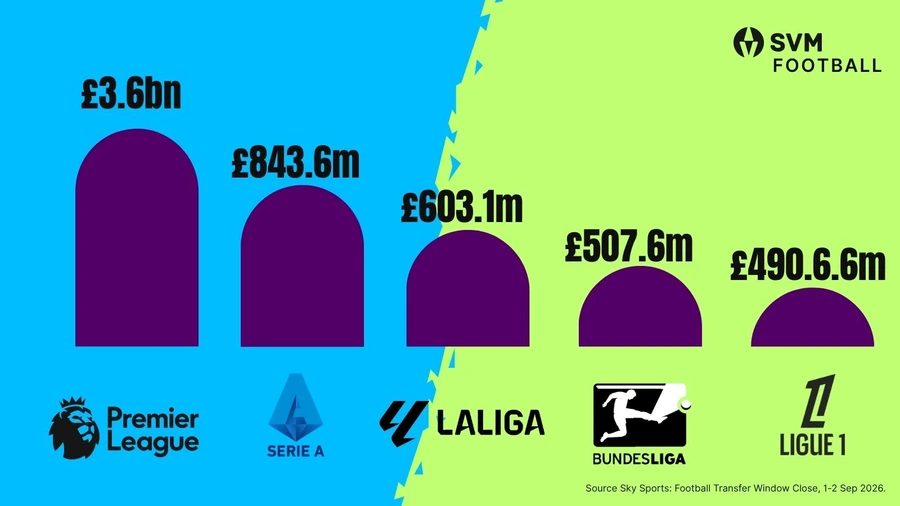
Premier League Transfer Market: Buyer Of Last Resort
Premier League clubs spent a record £3.56bn in summer 2026 while Ligue 1 banked a £511.3m surplus. The gap is not wealth. It is two different business models.

Spain Are World Champions: La Roja Outlast Argentina to Win World Cup 2026
Spain are champions of the world again. Sixteen years after their first title, Luis de la Fuente's side beat Argentina 1-0 after extra time at the New York New Jersey Stadium, with substitute Ferran Torres settling a bad-tempered final and ending the reigning champions' reign.

Spain vs Argentina: The World Cup 2026 Final in Numbers
Spain arrived as the tightest defence in 60 years. Argentina arrived as the comeback kings with a 39-year-old still rewriting the record book. The World Cup 2026 final is a clash of two football identities, and the Opta numbers tell the whole story.

England 6-4 France: Anatomy of a 10-Goal Bronze-Final Classic
Saka's hat-trick, Mbappe's record, a 4-0 lead nearly blown: the player performances, manager calls and key moments behind England 6-4 France.
Tuchel vs Deschamps: Two Tactical Blueprints, One World Cup Lesson
How Thomas Tuchel's possession machine and Didier Deschamps' transition game shaped England and France at the 2026 World Cup, read through the performance data.