England's Road to the Semi-Finals: The Players Who Drove It
Five stages, one semi-final place, and a set of players who each turned up when it counted. From Kane's finishing to Bellingham's record run to a night with ten men in the Azteca, here is how England actually got here - and who carried them.
Runs like this are rarely about one moment. England reached the World Cup 2026 semi-finals through five distinct tests, and each one asked a different question. What ties the journey together is not a single hero but a small group of players who kept answering, stage by stage. Strip the campaign back to its receipts and a clear picture emerges of who has actually carried this team.
𝗕𝗘𝗟𝗟𝗜𝗡𝗚𝗛𝗔𝗠 PUSHES 𝗘𝗡𝗚𝗟𝗔𝗡𝗗 𝗧𝗛𝗥𝗢𝗨𝗚𝗛.
— SVM | Football, Decoded (@SVMFootball) July 11, 2026
England 2-1 Norway (FT)
Schjelderup put Norway in front
(36', Ødegaard the architect).
Bellingham levelled on the stroke of
half-time (45'+2, Gordon assist),
then struck again deep in stoppage time
(90'+3) to… pic.twitter.com/LfizicJIeK
Stage by stage: how the road was built
England topped their group and did it without ever losing control of a match. A 4-2 win over Croatia set the tone, a win over Panama followed, and a draw with Ghana was enough to finish first. The through-line under Thomas Tuchel has been possession and structure - a control team built to keep the ball, pin opponents deep and manufacture chances for its finishers rather than trade blows.
The Round of 32 was the first real scare. Congo DR led early before England responded to win 2-1, a night defined by Harry Kane's refusal to let the game drift. The Round of 16 was the campaign's wildest chapter: a 3-2 win over co-hosts Mexico at the Azteca, played out with ten men after Jarell Quansah's red card, and settled by a Jude Bellingham double and a Kane penalty. Coming through a hostile Azteca, a man down, is the kind of test that tells you more about a team than a comfortable win ever could.
The quarter-final against Norway followed the same emotional script. Andreas Schjelderup put Norway ahead on 36 minutes, only for Bellingham to level in first-half stoppage time and strike again deep into the closing stages for a 2-1 win. Norway's Erling Haaland, who had arrived with seven goals, was kept without a clear sight of goal - a quiet reflection of England's defensive discipline on the night. The reward is a semi-final in Atlanta on 15 July.
Jude Bellingham: the record-setting engine
If one player defines this run, it is Jude Bellingham. He has scored five goals at the tournament, becoming the first English midfielder to reach five or more at a single World Cup and only the third England player to do it at all, after Gary Lineker in 1986 and Harry Kane. His goals have arrived at the decisive moments: one in the opening 4-2 win over Croatia, a double in the last-16 win over Mexico, and both goals in the quarter-final against Norway.
That is the profile of a knockout player. When England's possession finally turns into a genuine box threat, it has again and again been Bellingham arriving to finish it. For a midfielder to be the team's leading scorer at a World Cup is unusual; for him to be doing it in the games that decide tournaments is what elevates the story from good to historic.
Harry Kane: the record scorer, still the plan
Harry Kane arrived as England's all-time record scorer and has remained the axis of everything Tuchel builds. His six tournament goals include the brace that rescued the Round of 32 against Congo DR and the penalty that helped see off Mexico. Kane is the reference point the whole system is designed around - the striker who takes the most shots and occupies the most dangerous areas, drawing defenders and creating the space that players like Bellingham exploit. Even in games where he is not the scorer, his gravity shapes how England attack.
The supporting cast that made it work
A semi-final run is never a two-man effort. Anthony Gordon supplied the assist for Bellingham's crucial equaliser against Norway, the kind of wide contribution Tuchel's system relies on to turn control into end product. In goal, Jordan Pickford has anchored a back line that has kept England's defensive record respectable even through chaotic knockout nights, and the midfield platform of Declan Rice and Elliot Anderson has given the team the base to dominate the ball.
There is also a collective resilience worth naming. England have twice fallen behind or been pushed to the brink in the knockouts - trailing Congo DR, going a man down at the Azteca, falling behind to Norway - and each time they have responded rather than folded. That habit of answering pressure is its own form of quality, and it has been shared across the squad rather than owned by one name.
The tactical spine deserves credit too. Tuchel's control model, built on sustained possession and a compact defensive shape, is what allowed England to survive with ten men against Mexico and to smother a striker of Haaland's calibre in the quarter-final. It is not the most thrilling identity to watch minute by minute, but it is a repeatable one, and repeatability is what separates a deep run from a lucky one. The pieces have fit together: a finisher to build around, a midfielder finding the net at a historic rate, wide players supplying the final ball, and a goalkeeper and back line keeping the margins narrow enough for the front players to decide games.
𝗕𝗘𝗟𝗟𝗜𝗡𝗚𝗛𝗔𝗠. 𝗢𝗙 𝗖𝗢𝗨𝗥𝗦𝗘.
— SVM | Football, Decoded (@SVMFootball) July 11, 2026
Norway 1-1 England (45'+2)
Anthony Gordon delivers,
Jude Bellingham arrives to finish on
the stroke of half-time.
Same story as the last 16,
where his double sank Mexico.
When England turn possession into a box threat,
it's… pic.twitter.com/p1hFv2jeEe
Reading the run, not just the result
The value in mapping a road like this is that it turns a highlight reel into evidence. Bellingham's five goals, Kane's finishing, England's control model and their knack for surviving a scare were all readable as the tournament unfolded, not just visible in hindsight. Following form and performance as they build, ahead of the crowd, is exactly the edge SVMarkets is designed around at sportvalue.app.
England reach the last four on a blend of a record-breaking midfielder, a record-breaking striker, and a squad that keeps finding an answer. The semi-final will bring a new question. On the evidence of this road, the interesting part is watching which of these players steps up to answer it next.
Autor: John Dawson

Zona de desafíos
0 juegos disponibles
Últimas Noticias
Premier League Transfer Market: Buyer Of Last Resort
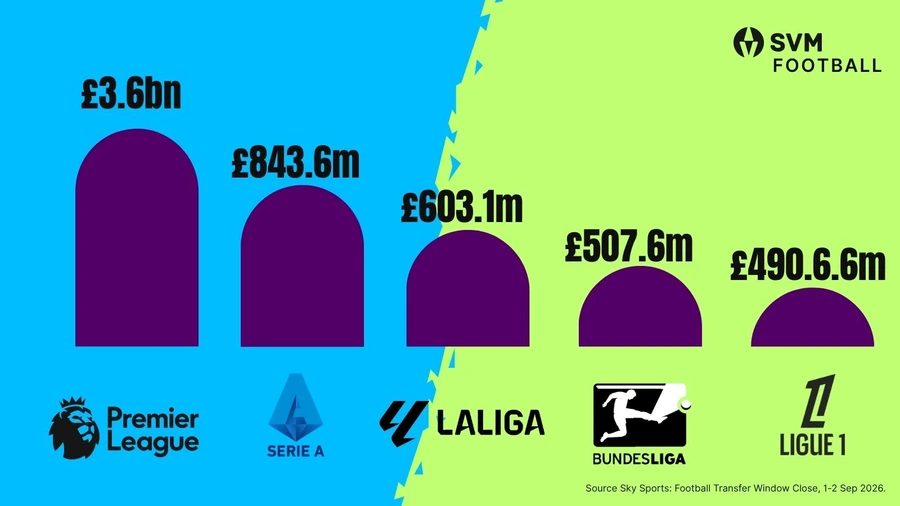
Premier League clubs spent a record £3.56bn in summer 2026 while Ligue 1 banked a £511.3m surplus. The gap is not wealth. It is two different business models.

Spain Are World Champions: La Roja Outlast Argentina to Win World Cup 2026
Spain are champions of the world again. Sixteen years after their first title, Luis de la Fuente's side beat Argentina 1-0 after extra time at the New York New Jersey Stadium, with substitute Ferran Torres settling a bad-tempered final and ending the reigning champions' reign.

Spain vs Argentina: The World Cup 2026 Final in Numbers
Spain arrived as the tightest defence in 60 years. Argentina arrived as the comeback kings with a 39-year-old still rewriting the record book. The World Cup 2026 final is a clash of two football identities, and the Opta numbers tell the whole story.

England 6-4 France: Anatomy of a 10-Goal Bronze-Final Classic
Saka's hat-trick, Mbappe's record, a 4-0 lead nearly blown: the player performances, manager calls and key moments behind England 6-4 France.
Tuchel vs Deschamps: Two Tactical Blueprints, One World Cup Lesson
How Thomas Tuchel's possession machine and Didier Deschamps' transition game shaped England and France at the 2026 World Cup, read through the performance data.